University-Affiliated Learning Collaborative introduces free, AI-enabled Calculus I courseware to improve student learning and gateway course outcomes
PITTSBURGH, PA (January 29, 2026) — Learnvia, a new university-affiliated nonprofit learning collaborative, today announced the launch of a national initiative to improve outcomes in high-enrollment gateway college courses, beginning with the release of its inaugural product: Learnvia Calculus I.
Developed in collaboration with Carnegie Mellon University (CMU) and the Gates Foundation, Learnvia brings together educators, institutions, and learning scientists to address one of the most persistent barriers in higher education. Gateway courses—particularly introductory mathematics—play an outsized role in determining students’ academic momentum, persistence, and access to STEM degrees and careers.
Learnvia’s purpose-built new courseware – starting with Calculus I – reflects the collaborative’s core approach: integrating evidence-based instructional practices, AI-enabled courseware, and learning research into a free-to-student solution designed to reduce DFWI rates, strengthen student performance, and support great teaching.
Gateway courses continue to represent one of the most significant challenges in postsecondary education. These high-enrollment, foundational courses account for disproportionate rates of failure and withdrawal, affecting an average of 30 percent of learners nationwide. For many students, these outcomes delay degree progress, increase costs, and can ultimately derail educational and career goals—particularly for first-generation students, working adults, and learners historically underserved by higher education.
Learnvia is being launched to address this challenge of gateway course success, beginning with a focus on post-secondary mathematics; the Mathematical Association of America (MAA) identifies introductory math as the single largest barrier to academic success in US post-secondary. The first course, Calculus 1, is representative of this challenge: more than 1 in 3 students fail or withdraw from Calculus, which is an early, critical course in many STEM degrees and career paths.
Backed by a $55 million philanthropic investment from the Gates Foundation, the new non-profit leverages CMU’s deep expertise in AI and learning science, builds on the Foundation’s extensive work in post-secondary education and engages with educators, institutions and associations who are working to improve learner success. Learnvia is designed to accelerate and strengthen these efforts through products that integrate instructional practice, educational technology and learning research to support students and faculty at scale.
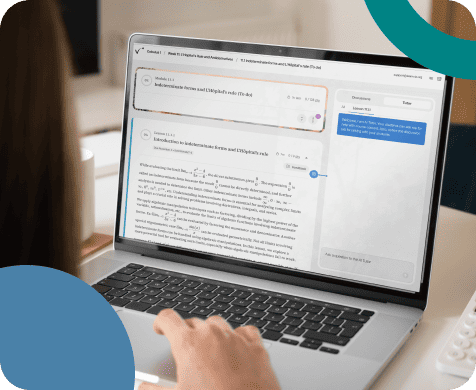
Learnvia courseware builds on proven approaches and carefully combines resources typically provided by disparate textbooks, homework systems and tutoring into carefully structured, guided lessons – with interactive video, scaffolded learning activities, embedded assessments with targeted hints and feedback and quizzes – and introduces new innovations, including AI-enabled features as well as peer and social learning supports.
This courseware is intentionally designed to enhance and encourage great teaching. Features and content support evidence-based teaching practices by facilitating active learning, strengthening metacognitive skills, and fostering a sense of belonging, while also cultivating a broader community of practice in which mathematics educators contribute to—and benefit from—the learning collaborative.
Learnvia embeds proven research into the instructional workflow, and actively drives a larger research-practice flywheel. The approach and platform are designed to engage with research at multiple levels, from enacting data-informed, continuous improvement loops to supporting broader insights into how humans learn – especially with technology and AI – through close collaboration with CMU researchers.
Designed by faculty, for faculty, Learnvia ensures that technology amplifies rather than replaces expert human instruction. Flexible course templates allow instructors to align courseware with existing syllabi and pedagogical goals, maximizing instructional impact while preserving academic autonomy.
“Our goal is to make student and faculty success the norm, not the exception.” said Norman Bier, Executive Director of the Simon Initiative, Open Learning Initiative and Learnvia. “Decades of research show that combining great teaching, effective courseware, and continuous learning research leads to real improvements. Learnvia builds on what works, introduces new innovations deliberately, and commits to an empirical, iterative approach that delivers consistent gains for students and educators.”
“The research-practice flywheel has been integral to our vision and our courseware development from the start,” explains Anita Delahay, director of research and development at Learnvia. “The platform prioritizes meaningful data collection and rapid cycle improvement, remaining deeply integrated with CMU’s learning science and AI research efforts. That combination allows us to continuously refine the learning experience based on evidence and impact.”
Features Designed to Help More Students Succeed
Learnvia Calculus I is a flexible, 14-week courseware solution designed to help students succeed in entry-level STEM requirements and remain on the path to a degree. By prioritizing active engagement over passive consumption, Learnvia helps students build mastery and earn credit, reducing false starts, strengthening metacognitive skills and fostering the confidence required to succeed in subsequent coursework.
- Instructional Videos and Guided Lessons: Short-form instructional ‘learn by doing’ videos and structured lessons grounded in learning science, designed to reinforce key concepts and align with instructor workflows
- Scaffolded Practice and Embedded Assessments: Problem sets, quizzes, and checks for understanding that build in complexity, helping students develop confidence and conceptual understanding as they progress
- Context-Aware AI-Powered Tutor: Adaptive guidance that responds to student performance over time, offering targeted hints and explanations based on how each learner engages with course content and assessments
- Instructor-Centered Course Tools: Analytics dashboards, assignment creation tools, and Learning Management System integration help educators pinpoint exactly where students are struggling to achieve mastery so that they can evolve their in-classroom priorities accordingly
Inclusive, Research-Based Design: Courseware validated by evidence-based instructional practices, including approaches with high-structure design and Universal Design for Learning to help reduce common learning barriers and support a wide range of learners
Opportunities to Collaborate Now Open
Beginning in Spring 2026, Learnvia is partnering with a diverse group of educators and post-secondary institutions, including community colleges, minority-serving institutions, and four-year universities, to gather feedback and refine the platform before full-scale rollout.
Faculty and Institutions interested in joining the collaborative, participating in the pilot, or learning more about Learnvia Calculus I may visit www.learnvia.org/pilot.
About Learnvia
Learnvia is a learning collaborative that develops next-generation courseware that integrates lessons, homework, quizzes, a discussion forum, and an AI tutor into a single, structured digital learning environment. Learnvia is a 501(c)(3) nonprofit organization established in 2025, led by experienced educators, researchers, and educational technologists dedicated to removing barriers to learning and accelerating student success through evidence-based innovation.