Announcement: Meet Learnvia at MAA MathFest 2026 in Boston, Booth #122!

NEW! FALL 2026
Calculus II
Courseware
Learnvia’s Calculus II courseware provides a research-informed, mastery-based approach to help students develop both conceptual understanding and procedural fluency.

Content Scope and Sequence
Chapter 1: Techniques of Integration
1.1 Integration by parts
1.2 Trigonometric integrals
1.3 Trigonometric substitutions
1.4 Partial fractions
1.5 Integration strategies
1.6 Approximation techniques for integration
1.7 Improper integrals
Chapter 2: Applications of Integration
2.1 Area between curves
2.2 Volumes by disks and washers
2.3 Volumes by shells
2.4 Arc length and surface area
2.5 Physical applications
Chapter 3: Introduction to Differential Equations
3.1 The nature of differential equations
3.2 Separable differential equations
3.3 Applications of differential equations
Chapter 4: Sequences and Series
4.1 Approximating functions with polynomials
4.2 Foundations of sequences
4.3 Convergence of sequences
4.4 Foundations of series
4.5 Convergence tests for series
4.6 Ratio test, root test, and absolute convergence
4.7 Power series
4.8 Taylor series
Chapter 5: Parametric and Polar Coordinates
5.1 Parametric equations and motion
5.2 Calculus of parametric curves
5.3 Polar coordinates and graphs
5.4 Calculus with polar functions
Calculus 2 Course Description
This configurable, 14-week Calculus 2 courseware supports student success in gateway math and strengthens retention in STEM pathways. The design integrates interactive lessons, structured practice, and just-in-time support to build deep conceptual understanding of foundational calculus ideas.
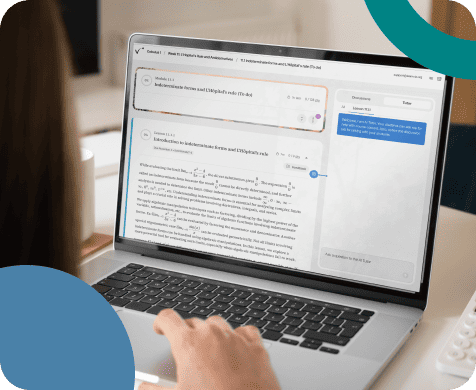
Short, scaffolded activities combine lessons, homework, quizzes, feedback, and AI-generated guidance within one intuitive system. Videos and interactives demonstrate key concepts, followed by multipart questions that lead students through real-world problem-solving and conceptual reasoning.
Short, scaffolded activities combine lessons, homework, quizzes, feedback, and AI-generated guidance within one intuitive system. Videos and interactives demonstrate key concepts, followed by multipart questions that lead students through real-world problem-solving and conceptual reasoning.
Topics covered:
- Advanced integration techniques and applications
- Differential equations and modeling
- Sequences, series, and convergence
- Parametric and polar coordinate systems
Key features:
- Balanced emphasis on conceptual understanding and procedural fluency
- AI-powered feedback providing real-time guidance and targeted support
- Continuously updated content aligned with best practices in calculus instruction
Developed by educators and grounded in learning science research, Calculus 2 courseware enhances instruction, promotes engagement, and helps more students succeed in mathematics
More About Learnvia Calculus 2 Courseware
Learnvia Calculus 2 combines effective teaching practices with adaptive technology in a cohesive, research-informed design. The courseware supports success in gateway mathematics and strengthens retention in STEM pathways. Every component is intentionally structured to foster engagement, comprehension, and persistence through active, scaffolded learning
Structured for Learning
The courseware is organized into chapters, modules, and short interactive activities that follow the rhythm of a college course. The default 14-week design can be easily adapted for alternative term lengths. Each chapter represents a week of instruction and includes several modules focused on two to four clearly defined learning outcomes.
Modules feature concise, ten-minute activities such as lessons, homework, and quizzes that encourage consistent progress and effective time management. This “bite-sized” format supports attention, pacing, and student motivation, allowing learners to engage meaningfully in shorter study sessions while retaining core ideas.
Designed for Clarity and Consistency
Each module follows a consistent pattern that builds conceptual understanding step by step:
- Lessons introduce new concepts through concise explanations, animated figures, and embedded questions that check understanding in real time.
- Homework provides randomized, auto-scored practice with hints, explanations, and unlimited attempts. Students can seek support but must solve a new version to earn credit, reinforcing mastery.
- Quizzes offer brief, auto-graded assessments aligned with lessons and homework, allowing students to demonstrate comprehension with confidence.
Research-Informed Learning Cycle
Each week, students move through a scaffolded cycle designed to deepen understanding:
- Engage and explore through guided lesson activities.
- Practice and apply with structured, feedback-rich homework.
- Assess and reflect through quizzes and reviews that consolidate learning.
This cycle reflects backward design principles where quizzes define learning goals, homework builds toward those goals, and lessons establish the conceptual foundation.
Pedagogical Foundations
Learnvia Calculus 2 is intentionally:
- Chunked: Short, focused activities sustain attention and promote incremental learning.
- Scaffolded: Support gradually decreases from lessons to homework to quizzes, developing student independence.
- Aligned: Every component connects through shared learning outcomes and knowledge–skill–ability (KSA) targets.
Integrated Support and Feedback
Built-in AI tutoring and discussion forums provide just-in-time support, while formative analytics give instructors real-time insight into student progress. Instant, actionable feedback helps close learning gaps before high-stakes assessments. This integrated support system encourages persistence and empowers both students and instructors to make data-informed decisions
Mobile and Accessible
Learnvia Calculus 2 is designed with a mobile-first approach that ensures seamless functionality on smartphones, tablets, and iPads. The responsive interface adjusts to any screen size, allowing students to review lessons, complete assignments, and check progress from any location. Optimized visuals, accessible navigation, and touch-friendly interactions create a consistent learning experience across all devices
Contributors
This configurable, 14-week Calculus 2 courseware supports student success in gateway math and strengthens retention in STEM pathways. The design integrates interactive lessons, structured practice, and just-in-time support to build deep conceptual understanding of foundational calculus ideas. Short, scaffolded activities combine lessons, homework, quizzes, feedback, and AI-generated guidance within one intuitive system. Videos and interactives demonstrate key concepts, followed by multipart questions that lead students through real-world problem-solving and conceptual reasoning.
Curriculum Committee
Matt Boelkins, Grand Valley State University
Victoria Frost, Spelman College
Dr. Dave Kung, independent consultant
Roberto Pelayo, University of California, Irvine
Candice Price, Smith College
Alicia Prieto-Langarica, Youngstown State University
April Strom, Chandler-Gilbert Community College
Aaron Weinberg, Ithaca College
Authors
Kathryn Boddie, University of Louisiana at Lafayette
Jordan Bounds, Learnvia
Chris Chan, Learnvia
Anne Collins, Learnvia
Ashlee Kalauli, Hawai’i Community College
Hesam Oveys, New York University
Roberto Pelayo, University of California, Irvine
Amit Vutha, The Ohio State University
Reviewers
Mark Atkins
Joseph Petrillo, Alfred University
Tam Tran, San Diego City College

Looking Ahead
Learnvia launched its first pilot program in Fall 2025 with Calculus I, continuing in Spring 2026. The pilot for Calculus II will launch in Fall 2026. Other gateway math courses will follow, Calculus 3, Precalculus, and Quantitative Reasoning. Over time, Learnvia will expand into other high-enrollment, high-attrition gateway courses while continually refining its platform based on faculty and student feedback.