
Part One: The Mission and Purpose
Learnvia is a nonprofit learning collaborative that brings educators and researchers together to improve student success in gateway math courses — courses that can open the door to degree completion, STEM pathways, and high-demand careers. By helping more students succeed in these critical courses, Learnvia aims to expand opportunity for students and strengthen the pipeline into fields that drive innovation.
Launched by Carnegie Mellon University in 2025 and generously supported by the Gates Foundation, Learnvia brings educators and researchers together to turn the science of learning into classroom practice. We pair smarter learning tools with faculty support, professional learning, peer collaboration, and continuous research to strengthen teaching and learning over time.
Gateway Courses Make or Break a College Career
Across the country, twenty courses account for roughly half of all enrollments at two-year institutions, and a third of enrollments at four-year institutions. On average, about 30 percent of the students in those courses end up with a D, an F, a withdrawal, or an incomplete. In a course like Calculus I, which falls into a sequence with Calculus II and III, a failing grade can push a student out of a STEM major, or out of college altogether. High-quality courseware and strong instruction, working together, can change that trajectory.
“Mathematics represents a key challenge for learners, and it also represents an opportunity to enact change,” says Norman Bier, Learnvia’s executive director. “Calculus has this tremendous impact in terms of how it allows students to advance to lots of different STEM degrees, and where those STEM degrees fit in terms of larger job growth.”
Supported by the Gates Foundation, Learnvia is driven by its mission to help all learners succeed in those critical gateway courses.
The Learnvia Approach
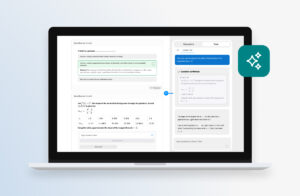
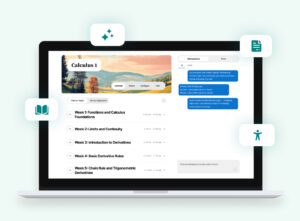
Learnvia’s approach brings together effective courseware, great teaching, and continuous learning research. Our courseware combines interactive lessons, homework, quizzes, discussion forums, and a built-in AI tutor in one digital environment. Faculty also have access to the Faculty Learning Exchange, a separate digital experience, along with professional development opportunities that support evidence-based teaching practices and help them make the most of their time with students. Research is embedded throughout this work, creating a research-practice cycle in which data, faculty and student feedback, and classroom experience drive continuous improvement.
We design, test, and continually improve the courseware. Our research approach is rooted in the learning sciences and Carnegie Mellon University’s decades of research at the intersection of cognitive psychology, education, and technology. At Learnvia, technology and teaching amplify one another—rooted in research, collaboration, and a shared commitment to equitable student success.
Part Two: Great Teaching, Smarter Tools, Better Learning
A closer look at how Learnvia combines courseware, teaching, and research to improve learning.
The anatomy of a Learnvia lesson
Learnvia’s courseware is built as a tightly structured, research-based learning journey rather than a set of disparate tools, combining lessons, homework, quizzes, discussion forums, and AI tutoring in one system.
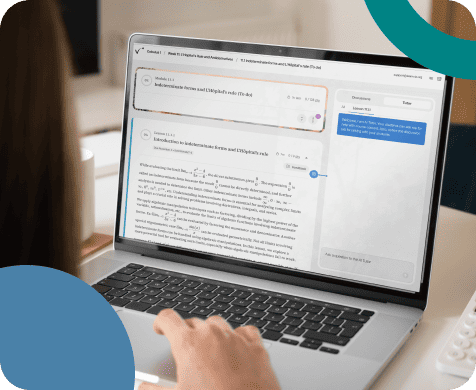
Each chapter opens with a short “why this matters” video, then moves into brief, highly focused framing text. From there, students work through frequent, low-stakes practice with step-by-step scaffolding designed to build confidence as well as competence, interspersed with highly interactive “learn by doing” videos and figures. When learners get stuck, they can reveal an example solution, but must then solve a fresh version of the problem, promoting productive struggle and limiting shortcuts. The AI tutor adjusts its help based on context, supporting real learning instead of simply handing over answers.
“What stands out to me is the emphasis on learning by doing. Students are prompted to engage, practice, and check their understanding throughout the lesson, which aligns well with how we know students learn mathematics,” says Zhenbu Zhang, a professor at Jackson State University who piloted the Calculus I course.
We Partner with Educators to Improve Teaching and Learning
Great courseware works best alongside great teaching, so we partner with institutions and faculty as they incorporate Learnvia into their classrooms. Faculty can draw on implementation support, professional learning, peer collaboration, and insights from student learning data to strengthen their courses. Just as importantly, their experience and feedback help shape Learnvia itself, making faculty active partners in the learning collaborative. Learnvia is designed by faculty, developed with extensive faculty input, and supported by Carnegie Mellon learning science.
Learnvia’s courseware supports and amplifies good teaching. “We know that technology by itself is not going to be what solves this problem,” says Bier. “We think that the key for seeing change is courseware that is able to amplify and accelerate great instructional practices.”
Learnvia is designed to help instructors offload much of the before- and after-class work. The courseware supports three modes of learning: pre-class preparation, where instructors assign short, autograded activities that introduce key concepts before class; in-class alignment, where instructors can mark specific activities as “covered in class” so students don’t need to complete them beforehand, tailoring the courseware to the flow of a particular section or teaching style; and post-class practice, where homeworks, quizzes, and practice sets are all autograded, with results pushed automatically into the gradebook. The goal is to free up in-class time for deeper work, like examples, group activities, peer learning, and discussion, while making sure students are still learning between sessions.
Let’s Turn the Science of Learning Into Classroom Practice
“Decades of research in mathematics education show that student learning improves when instruction is intentional, structured, and grounded in evidence. Initiatives that translate this research into classroom practice are critically important,” says Vijay J. Kunwar, a Learnvia faculty adopter at Albany State University.
Learnvia’s welcomes mission-aligned partners who are interested in exploring and developing innovative new teaching and learning solutions to ensure more students complete critical math courses with measurable learning gains.
Calculus I is available for general adoption. Calculus II is in pilot and will be available for general adoption for Spring 2027. Calculus III, Precalculus, and Quantitative Reasoning are coming soon. Subscribe for more information about Learnvia’s current and future courses.