
A nonprofit learning collaborative launched by Carnegie Mellon University, Learnvia brings educators and researchers together to turn the science of learning into classroom practice, grounded in CMU’s decades of research at the intersection of cognitive psychology, education, and technology.
Every decision about Learnvia’s courseware is based on foundational design principles, derived from learning research, that address how information is broken into pieces that match students’ cognitive capacity, how that information is presented, and how to support students’ development of both procedural and conceptual mastery.
Here is a closer look at six of those research-based design principles.
Teach Through a Static Figure First, Then Unveil It
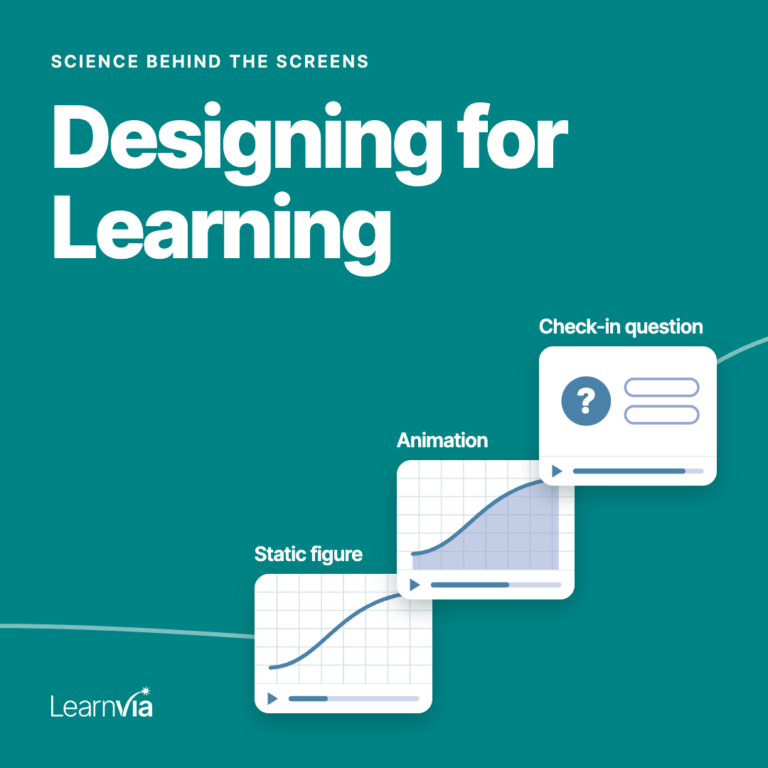
Research on multimedia learning shapes how Learnvia introduces new mathematical concepts and ideas. Learnvia first introduces a concept with a carefully thought-out static figure, then minimal explanation and an aligned animation. The goal is to scaffold the information, without asking students to process extraneous information that doesn’t support learning the concept. Narration and motion always stay in sync: every visual change has narration, and every narrated sentence has something happening on screen. Color is reserved for grouping or attention, never decoration. Research shows that the effect of this design choice is strongest for learners with less prior knowledge, so introductory lessons carry more scaffolding structural cues. Later parts of the activities have less scaffolding, because students already are starting to construct an internal schema of how the concept comes together.
Make Learning Questions a Dialogue
Students learn what they engage with and think about. Learnvia’s videos pause to ask students to make sense of what they have just seen, with clear explanations of both incorrect and correct answers so that students understand why a specific error happened, not just that it was incorrect. Learnvia gives students opportunities to compare strategies side by side, which builds procedural fluency. By showing multiple methods next to each other, Learnvia helps students figure out what works best for their particular way of thinking about mathematics . Research shows that well-integrated, clearly taught lessons can still lead to fragmented learning if nothing requires students to actively connect the pieces. To avoid this, Learnvia contains regular prompts guiding students to stop and make connections, providing them with opportunities to work through ideas.
Build Conceptual and Procedural Understanding Simultaneously
Learning research shows that a short lesson focused on conceptual understanding improves procedural knowledge, and vice versa. Carefully designed sequences of procedural questions can build conceptual understanding, and processes can rest on an understanding of the underlying concept. This is why the order of questions within a Learnvia lesson, homework, or self-quiz is fixed: each learning progression is designed to tease out concepts through questions that look procedural on the surface, and expose the relationships between those two types of understanding. An important design element of this principle is introducing any new notation clearly. For example, a dash can represent subtraction, a negative number, or other mathematical concepts, which can be confusing for students learning new ideas. Learnvia always explicitly addresses any operation or symbol that’s being used in a new or expanded way.
Call Out Misconceptions and Motivate the Big Ideas
Misconceptions are perfectly natural, because our brains make connections that later evidence may or may not support. Learnvia calls out those misconceptions and addresses them head-on, rather than letting them lie under the surface unexamined and become a stumbling block to future learning. One way to help break through misconceptions is through incorporating non-routine tasks: making sure that students are not always given tasks that look identical. Instead of memorizing a process, students have to apply their critical thinking to a slightly different context. For the same reason, problems use deliberately varied language to communicate the same ideas. Learnvia also includes question types that ask students to provide justification for their answer, as writing down an explanation can reveal misconceptions about the process that a correct answer obscures.
Ground Formalism in Real, Varying Quantities First
Tracking how two quantities change together is foundational to understanding functions, rate of change, and calculus. Learnvia’s “motivation-then-intuition-then-formula” sequence focuses on meaning before introducing formal terminology. Intuition lessons, like interactive videos where students actually see variables change together in real time, illustrate the concept before students approach naming variables or notation. This sequence builds the conceptual and the motivational understanding that students need, then introduces mathematical notation.
Build Belonging Through Task Design, Not Messaging
Principles that promote student belonging need to be embedded throughout the content. Learnvia does this in a few ways. Whenever possible, tasks allow for multiple solution paths and incorporate context varied across life domains to increase relevance for a wider audience. Learnvia’s “low floor, high ceiling” approach means that students at different levels can all access the material: hints support those who need more scaffolding, while others can move more directly through the components. Learnvia is also designed to promote a growth mindset, with explanations of both correct and incorrect answers that demonstrate that there is learning value in both scenarios. Of course, all of this is impossible if students do not actually have access to the content, so Learnvia’s mobile-first, single-access design makes the courseware accessible via computer, tablet, and cell phone.
Explore the Research Yourself
Learnvia’s mission is to design, test, and continually improve evidence-based courseware that is free to students and supports faculty in their teaching. Calculus I is available for general adoption. Calculus II is available for pilot users, Calculus III is in closed beta, and Precalculus, and Quantitative Reasoning are coming soon.