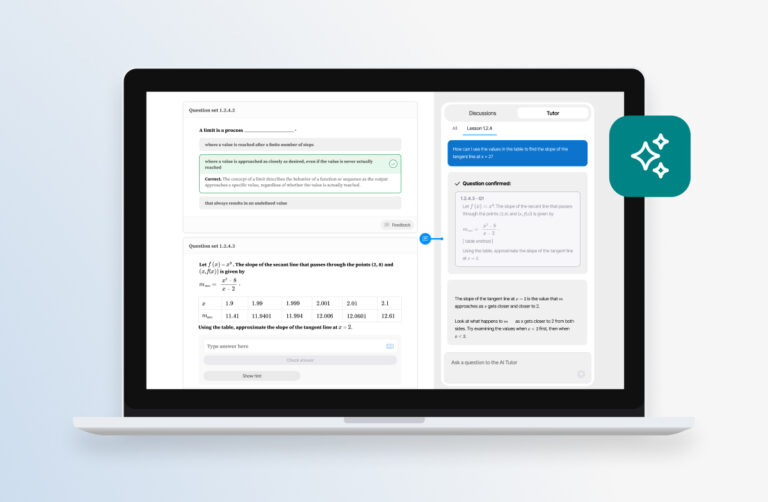

Learnvia’s embedded AI Tutor is engineered around one firm pedagogical principle constraint: help the student learn without doing the work for them.
When a student is struggling and asks the AI Tutor for help, the tutor can ask Socratic questions, point out key features of the problem that will help them figure out how to get started, and guide them through problem solving in “step by step” mode. It reveals a final answer only as a last resort, after a student has made genuine attempts and is clearly stuck.
To genuinely help students who are struggling, tutors (whether human or AI) need to encourage persistence and let students learn from mistakes. Learnvia’s AI Tutor offers support at the exact point of need, anchored to the actual course content and deliberately constrained to protect learning and academic integrity.
Learnvia’s AI Tutor is Grounded in the Course Itself
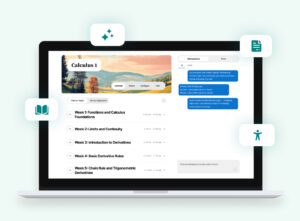
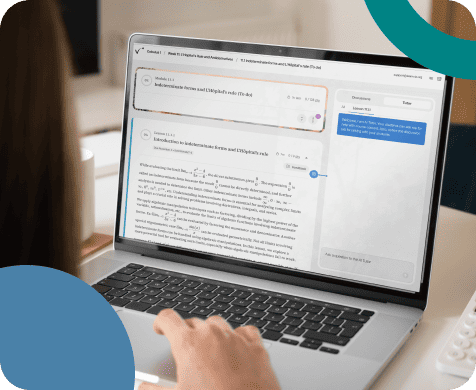
The AI Tutor is trained specifically on Learnvia’s own content. When it helps a student with a concept, it’s drawing on lesson text, hints, and pre-defined solution steps rather than the open internet or a language model’s general training. In other words, it knows which activity, lesson, and question a student is looking at, and it can respond to open-ended questions like “How do I start this problem?” Computations run through a dedicated math engine, and the tutor explains the verified result rather than eyeballing it the way a general-purpose model might. It also remembers the conversation history, so a student can leave and come back and pick up where they left off.
To Support Learning, an AI Tutor Needs to Provide the Right Amount of Help, at the Right Moment
The AI Tutor behaves differently when the student is working on different types of assignments, following research on how learning progresses. In Lessons, it offers full support, including providing complete worked solutions. Within Homework assignments, it shifts into step-by-step mode, asking guiding questions like “What do you think your next step is?” instead of handing over an answer. During a Self-Quiz, it isn’t available at all, so that a student’s score reflects their own understanding before full solutions and a retake become available. Then, after the quiz, students can review the solutions with the AI Tutor to understand their mistakes. The Tutor is intentionally designed to provide less support as students progress from lessons to homework to self-quizzes, gradually weaning them off assistance so they can build the independence needed to answer questions on their own during higher-stakes, in-class assessments.
“I liked that the AI Tutor feature allowed for quick help and guidance whenever I got stuck, making the learning process less frustrating.”
— Student, Jackson State University
“Using the Ai Tutor was helpful because it breaks things down step-by-step and shows me where I went wrong instead of just giving the answer.”
— Student, Cal State Los Angeles
The AI Tutor tailors its responses based on the question and assignment type. To protect student privacy, it is deliberately limited in what it knows about each learner. Names and emails are stripped out, and there’s no long-term model of a student’s strengths and weaknesses. The AI Tutor gives support on a problem-by-problem basis, rather than building a dossier on an individual student.
AI in the Classroom Needs to Protect Academic Integrity
As AI enters the classroom in more and more forms, we need to make sure that these tools align with what we know about how students develop skills, and avoid too-quick answers that undermine learning. Learnvia’s AI Tutor is effective because it’s anchored to the actual course content, aware of exactly where a student is stuck, and constrained to protect learning rather than to be maximally “helpful.”
Learnvia’s mission is to design, test, and continually improve evidence-based courseware that is free to students, supporting faculty in their teaching, and helping all learners succeed in critical gateway courses. Calculus I is available now for general adoption. Calculus II is piloting this fall, with Calculus III available for pilots in Spring 2027.