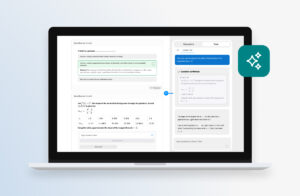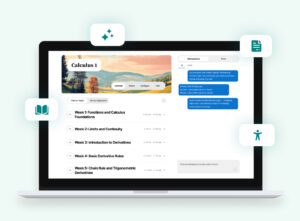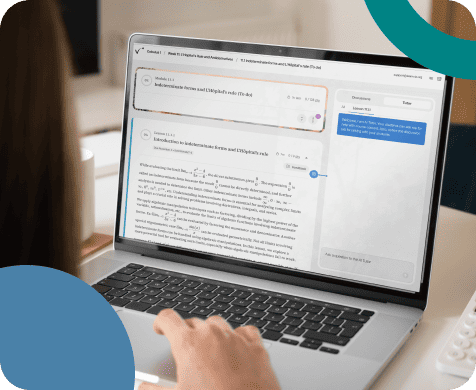

Learnvia’s approach to assessment is grounded in learning science, and every layer of support is calibrated to how students actually build understanding and confidence over time. Lessons, Homework, and Self-Quizzes in Learnvia give immediate feedback, and AI Tutor support available 24/7 helps students learn at an individualized pace through intentional, research-informed scaffolding — incremental steps instead of big jumps.
The Low-Stakes Assessment Progression
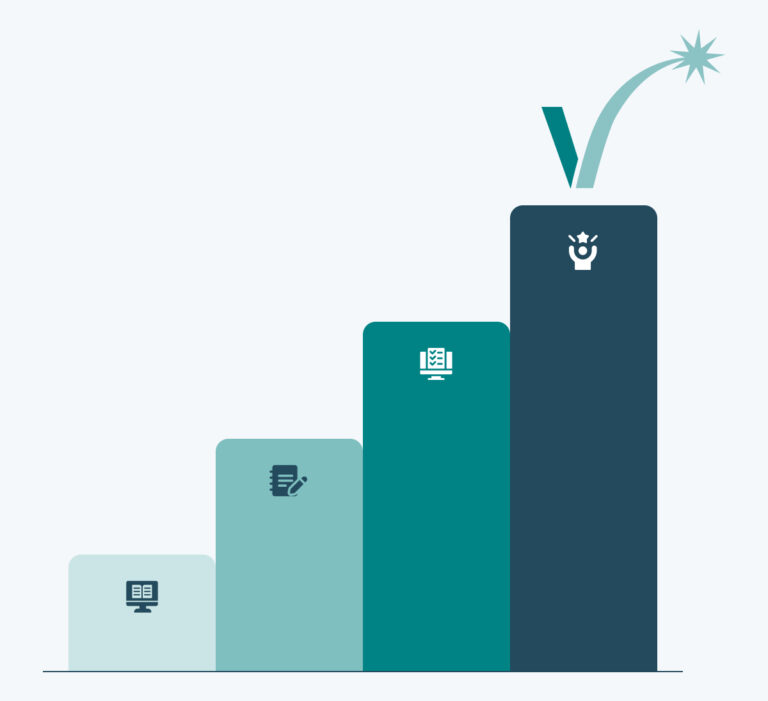
A three-step progression from Lessons to Homework to Self-Quiz promotes engagement, helps students track their own understanding, and fosters steady, low-anxiety progress across the course.
Support is tapered along four dimensions to foster independent learning: how many hints a question carries, whether the question content is presented in an explicit series of steps or as one question where students have to identify each step for themselves, whether the answer can be immediately revealed, and how much support the AI tutor will provide. All components of the progression allow unlimited attempts. Lesson and Homework questions require students to attempt a similar problem to earn credit after revealing the answer.
Lessons Introduce Concepts Through Interactive Video, Brief Text, and Scaffolded Questions.
- Difficulty: Answerable in one’s head in seconds, starting simple and building slightly harder
- Support: Full support, including two scaffolded hints for short answers, the answers and explanations can be revealed without losing credit, the AI tutor explains concepts and walks through examples, scored on participation
- Style: Video-embedded questions (very simple, 1–2 per video) and follow-up questions (still quick, slightly more challenging, may be multi-part or include one AI-graded long-answer question)
Homework Provides Practice – the “Now You Try It” Step.
- Difficulty: Some questions solvable mentally, others require pencil/calculator
- Support: Reduced, including one hint for short answers, revealing the answer generates a new randomized problem, the AI tutor nudges but will not solve, unlimited attempts
- Style: Mostly short and long answer, rarely multiple choice
Self-Quizzes Allow Students to Assess Their Preparation for In-Class Quizzes and Exams.
- Difficulty: Similar to or harder than homework, and graded for completion
- Support: None, including no hints, no AI tutor support until after submission, steps to solve the question are not given, students submit all answers at once to reveal correctness/score as well as worked solutions and are then able to retake the quiz with re-generated problems an unlimited number of times to boost confidence and prepare for higher-stakes in-class assessments
- Style: Mix of multiple choice, short answer, long answer
Backward Design Helps Create a Clear Progression From Learning to Practice to Assessment
In Learnvia, content is built from defined course and module learning outcomes, with lessons, homework, and self-quizzes designed to build toward increasingly complex applications of those skills. When instructors intentionally align their own assessments with those same outcomes, students can experience a more coherent connection between the work they do throughout the course and what they are ultimately expected to demonstrate.
Our authors start by defining about 20 course learning outcomes, then break each one down into 2–4 module learning outcomes, which are further broken down into hundreds of fine-grained KSAs (Knowledge, Skills, Abilities). From there, they work backward to build exam-worthy questions, then Self-Quiz questions that practice those exam skills, then homework that builds toward the Self-Quizzes, and finally lesson questions that build toward the homework.
This process keeps lessons focused (no extraneous content) and homework purposeful (not busywork). Students should never be surprised by a higher-stakes assessment, because they will have done questions in lessons (with full support), then built up to homework (with nearly full support), and may have even taken practice Self-Quizzes. Students have an easy way to get an accurate estimate of how they will do on an in-class quiz or exam, with access to more practice if they need additional preparation.
Completion vs. Score
In the gradebook, ”completion percentage” reflects completed activities, such as videos watched and questions answered correctly, regardless of timing. Progress is shown to students as an increasingly filled circle at the module and chapter levels, adding a gamified sense of progress on the table of contents. “Score” is a separate metric, counting only the correct completion attempts made before the assignment deadline. Both metrics are visible and transparent to students so the difference between “I did the work” and “I did the work on time for credit” is clear. Instructors can also view both metrics and may wish to give additional credit for work completed after the deadline.
Suggestions for Faculty
We recommend that faculty assign lessons and homework on a regular schedule to help students build a steady routine around the material. Keeping due dates predictable makes the rhythm of the course something students can plan around. Reinforcing that practice (not perfection) is the goal: the low-stakes structure works when students feel free to attempt, get things wrong, and try again, rather than feeling pressure to get every answer right the first time.
Curious to see this approach in action? Sign up for a Learnvia demo, led by a faculty member who has used Learnvia in their classroom, and see how the platform’s step-by-step support can work for your course.